

SIM New Jersey’s November meeting brought together a full house of technology leaders to talk about something every organization is wrestling with right now: how to connect data and AI in a way that creates real business impact.
The event, “Building Data Strategies that Actually Work in the Age of AI” was moderated by Alex Levy of the Stefanini Group and featured panelists Gabriel Martins, Aleksi Aaltonen, Mick Kless, and Mark Sander.
I attended as a guest of Pasquale Cirullo, Past President of SIM NJ, and left with plenty of insights about where organizations—and their data—need to go next.
1. Technology without purpose is wasted effort
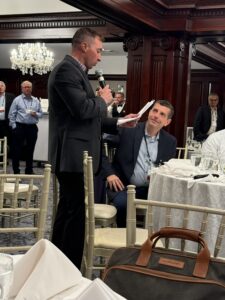
Moderator Alex Levy set the tone early: AI strategy isn’t a technology conversation — it’s a business one.
Throughout the evening, the panel returned to the same essential question:
“What problem are we trying to solve?”
Without that clarity, even well-intentioned AI initiatives can turn into “tech for tech’s sake,” adding complexity without delivering outcomes.
2. Data readiness is the real foundation
Mark, a longtime CIO in the pharma industry, shared a story about a company exploring an AI model for chemistry — only to discover that most of its critical data was still in handwritten lab notebooks.
It was the perfect illustration of a bigger truth:
AI depends on data that’s accurate, digital, and accessible.
Before organizations talk about AI, they need consistent documentation, digitized procedures, and thoughtful data governance — or the most promising ideas simply won’t scale.
3. Guardrails and governance come first

Mick Kless outlined four pillars of responsible AI:
- Transparency
- Explainability
- Accountability
- Responsible use
He also highlighted a growing blind spot — third-party vendor risk and shadow IT.
If employees or partners rely on unapproved tools, sensitive information can easily end up in the wrong place.
Good governance means knowing where your data goes, who touches it, and what safeguards exist along the way.
4. Making AI accessible — safely
Gabriel Martins shared how Stefanini built internal guardrails that allow employees across departments to experiment with AI safely.
Instead of restricting access to a few experts, they focused on making AI tools easy to use, secure, and available company-wide — paired with training and strong data protections.
It was a great real-world example of “AI democratization”:
making AI practical and usable for everyone, not just technical teams.
5. Start small to scale smart
When asked how organizations should begin, the panel agreed: start with small, focused wins.
Even large initiatives can succeed “in small bites,” as Mark put it, if each phase creates visible impact.
This approach builds confidence, reduces risk, and helps teams learn before scaling.
6. Keep what matters — not everything

With data growing exponentially, keeping “everything just in case” isn’t sustainable.
The panel discussed how modern tools now help:
- identify private or sensitive information
- tag and categorize data
- scrub what doesn’t need to be retained
As Mick noted, good governance isn’t about hoarding data — it’s about curating it thoughtfully.
7. A new mindset for AI
Aleksi Aaltonen added an academic lens, noting that AI behaves very differently from the software most organizations are used to.
Traditional systems give the same answer every time. AI doesn’t — it can produce different responses to the same question.
This unpredictability means companies need new ways to think about validation, trust, and oversight.
AI isn’t just a smarter search engine — it’s a new kind of system that requires a new mindset.
Closing Insight
Across all the perspectives shared, one idea tied everything together:
AI success isn’t about the tools — it’s about connection: connecting business goals, clean data, and skilled people.
Technology can absolutely be a differentiator — but only when those connections are strong.
A Welcoming, Engaged Community

One thing I always appreciate about SIM New Jersey is how warm and welcoming the community is. People go out of their way to include others, share ideas openly, and ask the kinds of questions that spark real conversation.
It’s a great place to learn, exchange perspectives, and meet people who are navigating similar challenges in technology and leadership.
Special thanks to SIM New Jersey and the Stefanini Group for hosting such an engaging and thought-provoking evening.