
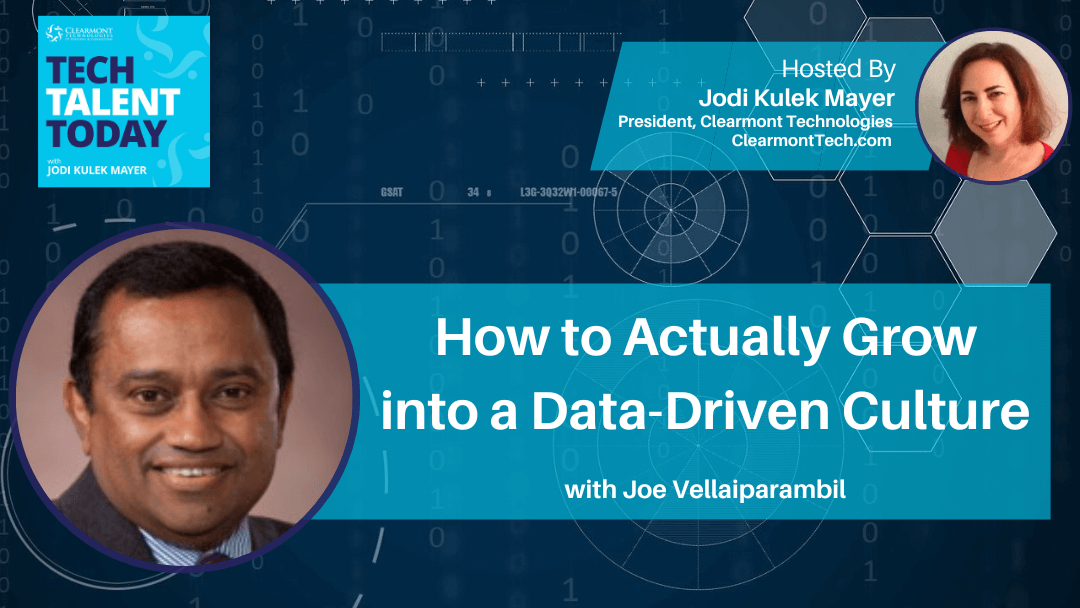
A company does not become data-driven just because it has dashboards, data scientists, or an enterprise strategy. For Joe Vellaiparambil, Chief Data & Analytics Officer at Equitable, the test is whether every leader who needs to make decisions has data-driven metrics in hand or can get to those metrics easily.
In this episode, Jodi talks with Joe about what it actually takes to grow into a data-driven culture: data literacy, accessible data, citizen data scientists, strong data foundations for AI, and technical teams that can turn data programs into business results.
For leaders, the talent implication is clear. Data and IT teams cannot be in every meeting, so companies need people across the business who can work with data, ask better questions, and help turn information into decisions. Joe also points out that hiring people trained in data and AI is not enough if the organization gives them outdated systems and limited room to apply what they know.
You will want to hear this episode if you are interested in…
- What it means for a company to become truly data-driven [02:24]
- Why data literacy has to be specific to the organization’s own data [03:27]
- How data marketplaces can reduce friction between business and IT [03:27]
- Why citizen data scientists matter when data and IT teams cannot be in every meeting [03:27]
- Why AI depends on strong data foundations [08:47]
- How data mesh and data fabric can help companies avoid stalled data warehouse projects [08:47]
- The talent needed to run data and AI programs [11:31]
- How companies can retain strong data talent with meaningful work and current technology [13:23]
The importance of data literacy
Every leader in an organization looks at the data ecosystem before making a decision. If a marketing executive understands the attribution, he can decide where the company needs to spend money and for which media. A sales executive with data can know precisely how profitable sales were. When every executive and leader can easily have data-driven metrics, that’s when a company is data-driven.
The journey to becoming a data-driven company is involved. One first step is ensuring the company has a good data literacy program. Developing a curriculum pertinent to the organization, and using the organization’s data, is a large part of that. The data needs to be easily accessible. Waiting two weeks for a data request is unreasonable. People need to have readily available data and tools to analyze the data. Having that ability is a massive step towards data literacy.
Enabling citizen data scientists
Often the onus is placed on the executives in an organization to drive adoption, but that overlooks an opportunity. Recent graduates are well-versed with data and AI, and that’s a constituency that needs to be developed. The data and IT teams cannot attend all meetings. The citizen data scientists step in during those times.
When a company hires highly talented and educated people and shows them archaic systems, these college grads’ enthusiasm is killed. Alternatively, if those people can translate what they’ve learned and channel their creativity into finding insights, they will thrive, and the company will benefit immensely.
Starting with data and AI
Some companies have chosen to build massive data warehouses. When finished, they realize that they missed several requirements or that what they made is now years behind the organization’s needs. Other organizations bring data fit for purpose, building point to point. Later they understand that concept is only as scalable as the number of resources they have. Data mesh and data fabric provide a middle ground between those two ideas. They harmonize some of the data needed from an enterprise perspective into enterprise assets. Then they build data products for easier consumption.
Eighty percent of AI is data. Much of the remainder is modeling the exploratory data analysis and finding suitable models. That aspect is also vital in getting good data scientists who can build models and understand behavior and propensity. Then the IT organization needs to have the skill to implement and make incremental changes based on what the data programs are showing. Making this change is a phased approach that can’t wait three to four years. It has to start now, and the ROI needs to be proven within the first three to six months.
When every executive and leader can easily have data-driven metrics, that’s when a company is data-driven. #Leader #DataLiteracy Share on XResources & People Mentioned
Connect with Joe Vellaiparambil
Connect With Jodi Kulek Mayer
- https://clearmonttech.com/about/meet-the-team/
- Follow Jodi on LinkedIn
Subscribe to Tech Talent Today on
Apple Podcasts, Spotify, Google Podcasts
Audio Production and Show notes by
PODCAST FAST TRACK
https://www.podcastfasttrack.com